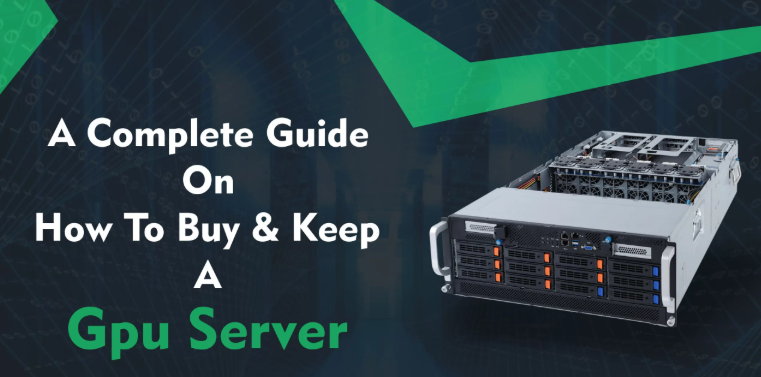
GPU server procurement in the UAE has become a strategic decision for enterprises, government organizations, research institutions, AI startups, data centers, and organizations building private AI infrastructure. As demand for generative AI, LLM training, inference, computer vision, and high-performance computing continues to grow, buyers need to evaluate much more than the GPU itself.
A successful GPU server purchase in the United Arab Emirates requires careful consideration of GPU selection, HBM capacity, server architecture, networking, storage, power, cooling, warranty, supply chain, export compliance, customs, VAT, lead time, and total cost of ownership.
This buyer's guide explains the key factors to consider when procuring AI servers in the UAE in 2026.
---
## Why GPU Server Procurement Is Different in 2026
A GPU server is no longer simply a conventional server with several graphics cards installed.
Modern AI systems can include:
* High-end NVIDIA or AMD accelerators
* Large amounts of HBM
* Multi-GPU interconnects
* NVLink or high-speed GPU fabrics
* 400 Gb/s or 800 Gb/s networking
* RDMA-capable NICs or SuperNICs
* High-performance NVMe storage
* Advanced power delivery
* Direct-to-chip liquid cooling
This means that choosing the wrong server configuration can leave expensive GPUs underutilized.
The objective should therefore be:
GPU + server + network + storage + cooling + software = complete AI platform
---
# 1. Define the AI Workload Before Buying
The first step in GPU server procurement should not be choosing a GPU.
Start by defining the workload.
Are you building the infrastructure for:
* LLM training?
* Fine-tuning?
* RAG?
* Generative AI inference?
* Computer vision?
* Speech AI?
* Multimodal AI?
* Scientific computing?
* HPC?
* Virtualized GPU workloads?
Different workloads require very different hardware.
For example, an 8-GPU NVIDIA H200 server may be appropriate for large-model training, while a smaller 1-GPU or 4-GPU server could be significantly more economical for enterprise inference.
---
# 2. Choose the Right GPU
The UAE market provides access to several generations of enterprise accelerators.
Common options include:
### NVIDIA Hopper
* H100
* H200
### NVIDIA Blackwell
* B200
* B300
* GB200
* GB300
### NVIDIA Professional / Inference GPUs
* RTX PRO 6000 Blackwell
* RTX 6000 Ada
* L40S
### AMD Instinct
* MI300X
* MI325X
* MI350X
* MI355X
The right choice depends primarily on memory, performance, workload, software compatibility, and total cost.
Do not select a GPU solely because it has the highest theoretical TFLOPS.
---
# 3. HBM Capacity Can Matter More Than Raw Compute
For LLM workloads, GPU memory is often one of the most important specifications.
Large models require substantial memory for:
* Model weights
* Activations
* KV cache
* Gradients
* Optimizer states
* Intermediate tensors
A GPU with more HBM can sometimes reduce the number of GPUs required for a particular workload.
When comparing GPUs, evaluate:
HBM capacity + HBM bandwidth + compute performance
rather than compute performance alone.
---
# 4. Determine the Number of GPUs
GPU count should be calculated from the workload.
For example:
1 GPU
Suitable for:
* Development
* Small inference workloads
* Prototyping
* Computer vision
4 GPUs
Suitable for:
* Enterprise AI
* Medium-scale inference
* Fine-tuning
* Smaller distributed workloads
8 GPUs
Suitable for:
* LLM training
* Large-model fine-tuning
* High-throughput inference
* HPC
Multiple 8-GPU servers
Suitable for:
* Distributed LLM training
* Large-scale inference
* AI clusters
* Enterprise foundation-model development
The optimal configuration depends on the required throughput and model size.
---
# 5. Select the Server OEM
A GPU is only one component of the system.
Major enterprise server vendors offer different approaches to GPU infrastructure, including:
* Supermicro
* Dell Technologies
* HPE
* Lenovo
* ASUS
* Gigabyte
The choice should be based on:
* GPU compatibility
* CPU platform
* GPU interconnect
* Networking
* Storage
* Power
* Cooling
* Warranty
* Local support
* Firmware lifecycle
For UAE enterprise deployments, local support and warranty coverage can be just as important as the initial hardware price.
---
# 6. 8-GPU Servers vs Smaller GPU Servers
An 8-GPU server is often the preferred building block for distributed AI training.
A typical cluster might look like:
8 GPUs × 8 servers = 64 GPUs
or:
8 GPUs × 32 servers = 256 GPUs
The advantage is a standardized node architecture that simplifies:
* Cluster management
* Networking
* Scheduling
* Software deployment
* Spare parts
* Maintenance
However, 8-GPU servers can be excessive for smaller inference applications.
For inference, multiple 1-GPU or 4-GPU servers may provide better flexibility.
---
# 7. Don't Forget the Network
For multi-node AI training, networking is critical.
A cluster can contain extremely powerful GPUs but still deliver poor performance if the scale-out network becomes the bottleneck.
Consider:
* InfiniBand
* RoCE
* High-speed Ethernet
* 400 Gb/s networking
* 800 Gb/s networking
* RDMA
* SuperNICs
* Network topology
For large LLM training clusters, benchmark all-reduce, all-gather, reduce-scatter, and all-to-all rather than relying solely on advertised switch bandwidth.
---
# 8. NVLink vs Network Fabric
Inside a high-end GPU server, GPU-to-GPU communication can use technologies such as NVIDIA NVLink.
Between servers, the cluster requires a scale-out network.
This creates two different communication layers:
GPU → GPU inside server
and
Server → Server across the cluster
Both need to be designed together.
A powerful internal GPU fabric cannot compensate for an undersized external network.
---
# 9. Storage Is Part of the GPU Server
AI training generates enormous data volumes.
A procurement specification should therefore include:
* NVMe SSDs
* Local scratch storage
* Shared storage
* Dataset storage
* Checkpoint storage
* Backup
* Object storage where appropriate
A cluster with insufficient storage throughput can leave GPUs waiting for data.
For large training environments, evaluate storage performance using the actual dataset and training pipeline.
---
# 10. Power and Cooling in the UAE
Power and cooling deserve particular attention in the UAE because high-density GPU infrastructure can create substantial thermal loads.
A GPU server may require significantly more power than a conventional enterprise server.
A complete rack calculation should include:
GPU + CPU + memory + networking + storage + fans + power-supply overhead
Then calculate the resulting rack-level heat load.
For high-density Blackwell and other next-generation AI platforms, direct-to-chip liquid cooling may be required depending on the system and rack configuration.
Before purchasing, confirm that the target UAE data center supports:
* Required rack power
* Electrical redundancy
* Appropriate PDU configuration
* Cooling capacity
* Rack weight
* Liquid cooling if required
* Network connectivity
---
# 11. Data Center Location Matters
The UAE offers multiple data-center and logistics environments.
A buyer should distinguish between:
Mainland UAE deployment
and
Free-zone logistics or staging
The customs and tax treatment can differ depending on the transaction and import/export structure.
Dubai Customs provides an integrated tariff system for classifying imported goods using the GCC's harmonized customs structure. Correct HS classification is important for determining applicable duties and ensuring smooth customs clearance. ([Dubai Customs][1])
Do not rely on a supplier's informal assumption about customs treatment. Ask for the proposed HS classification, country of origin, customs value, and importer-of-record structure before placing a large order.
---
# 12. UAE VAT and Import Costs
The UAE standard VAT rate is 5%. ([Ministry of Finance][2])
For imported goods, the Federal Tax Authority states that import VAT is generally charged at 5% unless a specific zero-rating or exemption applies. The taxable import value can include customs value, insurance, freight, customs fees, and other applicable amounts. ([FTA UAE][3])
Therefore, an international GPU server quotation should not be compared directly with a UAE delivered quotation.
Ask suppliers to clearly separate:
* Hardware price
* Freight
* Insurance
* Customs duty
* Import VAT
* Local delivery
* Installation
* Commissioning
* Support
This gives you the true landed cost.
---
# 13. Customs Classification
GPU servers should be correctly classified before shipment.
Dubai Customs provides an official HS-code classification platform that can be used to determine the appropriate commodity classification and associated duty or restriction information. ([Dubai Customs][4])
For large-value AI infrastructure, incorrect classification can result in:
* Clearance delays
* Unexpected charges
* Documentation problems
* Customs disputes
* Delayed deployment
Your procurement team should therefore obtain customs documentation before the hardware ships.
---
# 14. Export Compliance Is Critical
High-performance AI accelerators are subject to international export-control considerations.
This is particularly important for advanced NVIDIA GPU platforms.
A reputable supplier should be able to explain:
* Export jurisdiction
* End-user requirements
* End-use requirements
* Required documentation
* Country-of-destination screening
* Manufacturer restrictions
* Compliance responsibilities
Do not purchase high-end AI GPUs through an opaque supply chain simply because the price or promised delivery date looks attractive.
The cheapest quote can become the most expensive option if the hardware cannot be legally shipped, supported, or warranted.
---
# 15. Avoid Grey-Market GPU Servers
One of the biggest procurement risks in the AI hardware market is the grey market.
Warning signs include:
* Unusually low pricing
* No manufacturer warranty
* Unknown GPU serial numbers
* Missing original documentation
* Unclear country of origin
* “New” hardware with unexplained packaging
* Used GPUs marketed as new
* No clear end-user documentation
* Unverifiable distributor status
For a production AI cluster, hardware traceability matters.
A legitimate procurement process should provide:
Serial numbers + OEM documentation + warranty confirmation + supply-chain traceability
---
# 16. Ask for a Complete BOM
Never evaluate a GPU server quote based only on:
“8 × NVIDIA H200”
The complete bill of materials should specify:
### GPU
* Exact GPU model
* Memory
* Form factor
* Quantity
### CPU
* Processor model
* Number of CPUs
### Memory
* Capacity
* DIMM configuration
* Speed
### Storage
* NVMe capacity
* RAID configuration
* Boot drives
### Networking
* NIC/SuperNIC model
* Port speed
* Number of ports
### Power
* PSU quantity
* PSU rating
* Redundancy
### Cooling
* Air cooling or liquid cooling
* Cold plates
* CDU requirements
### Software
* NVIDIA drivers
* CUDA
* Enterprise software
* Cluster management
A complete BOM makes supplier comparisons much more accurate.
---
# 17. Evaluate Warranty and Support
For expensive AI servers, warranty terms are critical.
Ask:
* Is the warranty local UAE support?
* Where is the repair center?
* What is the response time?
* Is onsite service included?
* Are GPU replacements included?
* Are parts stocked in the UAE?
* What happens if a GPU fails?
* Is firmware support included?
* Is software support available?
An AI server with eight high-value GPUs represents a significant concentration of capital.
A long replacement cycle can have a major operational impact.
---
# 18. Lead Time Matters
GPU availability can vary substantially between models and configurations.
Do not accept:
“Available”
as sufficient information.
Ask whether the supplier means:
* In stock in UAE
* In stock in Dubai
* In distributor inventory
* Allocated by manufacturer
* Available from factory
* Subject to export approval
* Estimated production date
The difference can be weeks or months.
Some UAE suppliers currently advertise H100/H200/B200/B300 availability through sourcing channels, while also noting that allocation and lead times vary by model. ([Haink][5])
---
# 19. Ask for a Firm Delivery Milestone
For large GPU purchases, include delivery milestones in the commercial agreement.
For example:
PO → Allocation → Manufacturing → Export clearance → UAE arrival → Customs → Data-center delivery → Installation → Acceptance test
This provides much better visibility than a single estimated delivery date.
---
# 20. Acceptance Testing
Do not consider the project complete when the boxes arrive.
A production GPU cluster should go through an acceptance test.
Test:
### GPU
* GPU detection
* HBM capacity
* ECC
* Thermal behavior
* GPU stress testing
### Network
* Bandwidth
* Latency
* RDMA
* Multi-node communication
### Storage
* Read/write throughput
* Dataset access
* Checkpoint performance
### Software
* Driver installation
* CUDA
* NCCL
* Container runtime
* Monitoring
### Cluster
* Multi-node scaling
* GPU utilization
* Failure recovery
For an AI training cluster, ideally benchmark an actual representative workload before final acceptance.
---
# 21. Calculate Total Cost of Ownership
The purchase price is only the beginning.
A useful TCO model is:
TCO = Hardware + Networking + Storage + Power + Cooling + Support + Software + Facilities
Then compare this against:
Useful AI compute delivered
A more meaningful metric can be:
Cost per training token
or:
Cost per million inference tokens
This allows you to compare different GPU generations and cluster configurations based on actual business output.
---
# 22. UAE Procurement Checklist
Before signing a GPU server purchase order, verify:
### Technical
* [ ] GPU model
* [ ] GPU quantity
* [ ] HBM capacity
* [ ] CPU
* [ ] RAM
* [ ] NVMe
* [ ] GPU interconnect
* [ ] Network adapter
* [ ] Network speed
* [ ] Power requirements
* [ ] Cooling requirements
### Commercial
* [ ] Unit price
* [ ] Complete BOM
* [ ] UAE landed price
* [ ] VAT treatment
* [ ] Customs responsibility
* [ ] Freight
* [ ] Installation
* [ ] Warranty
* [ ] Support SLA
### Supply Chain
* [ ] Manufacturer
* [ ] Authorized channel
* [ ] Country of origin
* [ ] Serial-number traceability
* [ ] Export compliance
* [ ] End-user documentation
* [ ] Confirmed allocation
* [ ] Delivery milestone
### Deployment
* [ ] Rack space
* [ ] Power capacity
* [ ] Cooling
* [ ] Network ports
* [ ] Storage
* [ ] Data-center access
* [ ] Acceptance testing
---
# 23. Buying GPU Servers vs Renting GPU Cloud
UAE organizations should also compare CapEx GPU ownership with GPU-as-a-Service.
### Buy GPU Servers
Best when:
* GPU utilization is consistently high
* Workloads are predictable
* Data sovereignty is important
* Long-term ownership is preferred
* Infrastructure already exists
### Rent GPU Capacity
Best when:
* Demand is variable
* Projects are short-term
* Capital expenditure should be minimized
* Rapid scaling is required
* The organization does not want to operate GPU infrastructure
For organizations with sustained utilization, purchasing can become economically attractive. For unpredictable workloads, cloud or managed GPU infrastructure can reduce financial risk.
---
# 24. Government and Enterprise Procurement
For UAE government procurement, the process may involve additional registration and tender requirements.
The UAE Ministry of Finance operates a Federal Supplier Register and Digital Procurement Platform through which eligible suppliers can register, participate in tenders, negotiate contracts, submit purchase orders and invoices, and track procurement activities. ([Ministry of Finance][6])
Enterprise buyers should similarly establish a formal vendor qualification process before requesting large GPU allocations.
---
# 25. The Best GPU Server Is Not Always the Most Powerful
A common procurement mistake is choosing the newest GPU simply because it offers the highest performance.
The better question is:
Which GPU delivers the lowest cost for my actual workload?
For example:
* Inference may favor memory efficiency and throughput.
* Fine-tuning may favor large HBM capacity.
* LLM training may prioritize GPU compute and interconnect.
* Computer vision may require fewer accelerators.
* RAG workloads may require more CPU, storage, and networking than GPU capacity.
The correct server is the one that maximizes useful workload performance per dirham.
---
# Final Takeaway
GPU server procurement in the UAE is a complete infrastructure decision—not simply a hardware purchase.
The strongest procurement strategy begins with the workload and works backward toward the hardware:
Workload → GPU → Server → Network → Storage → Power → Cooling → Data Center → Compliance → Support
For a small AI deployment, a single- or four-GPU server may be sufficient. For enterprise LLM training, an 8-GPU H200, B200, B300, MI300X, or MI355X platform may be a more appropriate foundation. At larger scales, procurement becomes a full cluster-design exercise involving high-speed networking, liquid cooling, storage, and data-center power.
For UAE buyers, also evaluate the landed cost, not just the hardware quotation. Import VAT, customs classification, freight, warranty, export compliance, and local support can materially affect the final economics. The UAE's standard VAT rate is 5%, while customs treatment depends on the goods' classification and applicable rules. ([Dubai Customs][1])
Most importantly, buy from a supply chain that can demonstrate genuine hardware, manufacturer warranty, traceable serial numbers, export-compliance documentation, and a realistic delivery commitment.
For high-value AI infrastructure, the cheapest quote is rarely the most important metric. The better objective is:
maximum reliable AI compute delivered in the UAE, at the lowest predictable total cost of ownership.