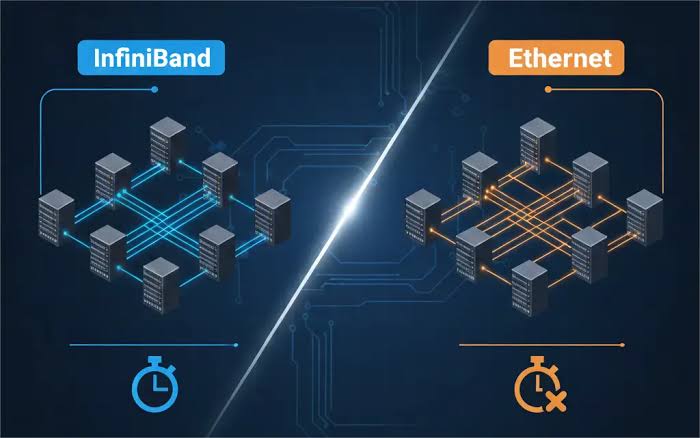
Choosing between InfiniBand and Ethernet for AI training is one of the most important networking decisions when building a multi-GPU or large-scale AI cluster. As large language models, generative AI, reasoning models, and distributed training workloads continue to scale, the network connecting GPUs can have a direct impact on training time, GPU utilization, scalability, and total infrastructure cost.
The decision is no longer simply “InfiniBand or Ethernet?”. Modern AI infrastructure increasingly compares InfiniBand with high-performance Ethernet using RDMA over Converged Ethernet (RoCE), including AI-optimized platforms such as NVIDIA Spectrum-X. Conventional Ethernet using standard TCP/IP is a different proposition and should not be treated as equivalent to a properly engineered RoCE fabric.
For large distributed AI workloads, the objective is to provide high bandwidth, low latency, predictable congestion behavior, efficient GPU-to-GPU communication, and reliable scaling across many nodes.
## Why Networking Matters for AI Training
AI training is highly dependent on collective communication.
When a model is distributed across multiple GPUs, those GPUs continuously exchange information during training operations such as all-reduce, all-gather, reduce-scatter, and all-to-all.
If communication is slow, GPUs can spend valuable compute time waiting for data from other GPUs.
This creates a simple principle:
Faster GPUs do not automatically produce faster AI training if the network cannot keep them synchronized.
As clusters scale from a single 8-GPU server to dozens or hundreds of GPU nodes, network performance becomes increasingly important.
NVIDIA's current AI factory architectures explicitly use a dedicated GPU compute fabric for AI training, fine-tuning, machine learning, and HPC workloads, with RDMA/RoCE recommended for that east-west network.
## InfiniBand vs Ethernet: The Basic Difference
InfiniBand is a networking technology designed from the ground up for high-performance computing and low-latency communication.
Ethernet is a broader networking standard used throughout enterprise and data-center infrastructure.
For AI clusters, however, Ethernet can be enhanced with RDMA over Converged Ethernet (RoCE) to provide direct memory access between systems without requiring traditional CPU-intensive networking paths.
This creates three practical categories:
1. InfiniBand
2. RoCE-based high-performance Ethernet
3. Conventional Ethernet/TCP/IP
The second category is the one that makes the comparison particularly interesting in 2026.
## What Is InfiniBand?
InfiniBand is widely used in HPC and large-scale AI environments because it provides:
* Low latency
* High bandwidth
* RDMA
* Efficient GPU-to-GPU communication
* Advanced congestion management
* Predictable behavior at scale
* In-network computing capabilities on supported platforms
NVIDIA's current Quantum-X800 platform provides 800 Gb/s InfiniBand, with features including adaptive routing, SHARP in-network computing, and advanced telemetry and congestion management.
For large, dedicated AI training clusters, these capabilities can make InfiniBand particularly attractive.
## What Is Ethernet for AI?
Traditional Ethernet is designed for general-purpose networking.
A conventional TCP/IP network can be perfectly adequate for:
* Management
* User access
* Storage
* Web services
* API traffic
* Inference applications
* General enterprise workloads
However, large-scale distributed AI training has much more demanding communication patterns.
This is where RoCE comes into play.
## What Is RoCE?
RoCE, or RDMA over Converged Ethernet, enables RDMA communication over Ethernet.
Instead of relying entirely on conventional TCP/IP networking, RoCE allows data to move directly between memory regions using RDMA mechanisms.
This can significantly reduce CPU overhead and latency.
However, high-performance RoCE requires careful network engineering.
A production RoCE fabric may involve:
* RDMA-capable NICs or SuperNICs
* Priority Flow Control (PFC)
* Explicit Congestion Notification (ECN)
* Appropriate QoS configuration
* Congestion management
* Loss-aware switching
* Correct buffer configuration
* Optimized network topology
* Compatible drivers and firmware
NVIDIA's current Spectrum-X networking documentation specifically highlights RoCE configuration with QoS, ECN, PFC, adaptive routing, and telemetry for high-performance AI networking.
## InfiniBand vs RoCE Ethernet
The real 2026 comparison for large AI clusters is therefore often:
NVIDIA Quantum InfiniBand vs NVIDIA Spectrum-X / optimized RoCE Ethernet
rather than InfiniBand vs ordinary Ethernet.
Both can provide extremely high bandwidth and RDMA-based GPU communication, but their architectures and operational models differ.
| Feature | InfiniBand | RoCE Ethernet |
| ----------------------------- | ------------------------ | ---------------------------------------- |
| RDMA | Native | Yes |
| Ethernet compatibility | No | Yes |
| Low latency | Excellent | Excellent when engineered correctly |
| Congestion management | Fabric-native mechanisms | PFC/ECN + platform-specific mechanisms |
| Existing Ethernet integration | Limited | Excellent |
| Multi-tenancy | Supported | Strong advantage with Ethernet platforms |
| AI training | Excellent | Excellent |
| HPC | Excellent | Very capable |
| Operational model | Specialized | Familiar to Ethernet teams |
| Hardware ecosystem | More specialized | Broader Ethernet ecosystem |
| Network complexity | Specialized | High for properly engineered RoCE |
## Performance: Which Is Faster?
There is no universal answer.
InfiniBand generally maintains an advantage in latency, determinism, and specialized collective-communication capabilities, particularly in dedicated HPC and AI fabrics.
However, properly engineered RoCE can achieve extremely high performance and can approach InfiniBand performance for many workloads.
Recent technical comparisons emphasize that RoCE can scale closely to InfiniBand when the network is correctly configured, while also noting that the results depend heavily on topology, congestion control, workload characteristics, and scale.
This is why theoretical link speed alone should not determine the decision.
An 800 Gb/s Ethernet network is not automatically equivalent to an 800 Gb/s InfiniBand fabric in real AI training.
The complete system matters.
## Latency Matters for Distributed Training
Latency becomes increasingly important as the number of GPUs increases.
Consider a distributed training workload where hundreds or thousands of GPUs need to synchronize.
Even small communication delays can accumulate across many collective operations.
InfiniBand is designed for this type of workload and provides a highly optimized fabric for low-latency communication.
RoCE can also provide low latency, but the network must be engineered correctly to avoid congestion, packet loss, head-of-line blocking, and inefficient traffic patterns.
## Bandwidth Is Equally Important
AI training moves enormous quantities of data.
The network must provide sufficient bandwidth to keep GPUs synchronized without becoming a bottleneck.
Modern AI fabrics have moved toward extremely high-speed connections, including 400 Gb/s and 800 Gb/s-class networking.
NVIDIA's current AI infrastructure documentation describes both InfiniBand and Ethernet platforms as part of its networking strategy for large-scale AI factories.
The important metric is not simply the advertised port speed.
Evaluate:
Effective application bandwidth + latency + collective communication efficiency + congestion behavior
rather than the raw network interface specification alone.
## InfiniBand and Collective Operations
One important advantage of NVIDIA's InfiniBand ecosystem is SHARP in-network computing.
Instead of requiring every GPU or CPU to perform all parts of a collective operation, supported network hardware can perform certain reductions within the network.
This can reduce communication overhead and improve the efficiency of collective operations.
For large-scale distributed training, where all-reduce operations can dominate communication traffic, in-network computing can be valuable.
## RoCE and Ethernet Flexibility
The major argument for RoCE Ethernet is flexibility.
Ethernet is already deeply integrated into enterprise data centers.
Organizations typically already have:
* Ethernet switches
* Ethernet cabling
* Ethernet management tools
* Network engineers
* Monitoring systems
* Security infrastructure
* Automation platforms
Using an AI-optimized Ethernet fabric can therefore reduce the separation between the AI cluster and the rest of the data center.
NVIDIA's current reference architectures use Ethernet-based RoCE fabrics for GPU compute, storage, and converged networking in several enterprise AI deployments.
## Multi-Tenancy: Ethernet's Strong Advantage
Multi-tenant environments introduce another consideration.
A dedicated InfiniBand cluster can be ideal when the infrastructure is primarily designed for a single organization or controlled workload environment.
Ethernet, particularly AI-optimized Ethernet platforms, can be attractive when multiple workloads, teams, or tenants need to share infrastructure.
This makes Ethernet particularly interesting for:
* AI clouds
* GPU-as-a-Service
* Enterprise private clouds
* Multi-tenant inference
* Shared research environments
* Cloud service providers
NVIDIA positions Spectrum-X specifically around Ethernet-based AI clouds and performance isolation for multi-tenant environments.
## Network Topology Matters More Than You Think
Selecting InfiniBand or Ethernet is only the beginning.
The topology can have a major impact on performance.
Large AI clusters commonly use leaf-spine architectures, with carefully designed GPU rails and redundant connections.
NVIDIA's current GB300 NVL72 reference architecture uses a spine-leaf Ethernet design with dedicated GPU compute networking and RDMA/RoCE support.
A poorly designed topology can create oversubscription and bottlenecks even when the switches and NICs have extremely high theoretical bandwidth.
## InfiniBand vs Ethernet for 8-GPU Servers
For a single 8-GPU server, the choice may not be as critical as it is for a large multi-node cluster.
Inside the server, technologies such as NVLink and NVLink Switch can provide extremely high-bandwidth GPU-to-GPU communication.
The external network becomes important when the workload scales across multiple servers.
For example:
8 GPUs → 1 server
primarily depends on the server's internal GPU interconnect.
But:
8 GPUs × 32 servers = 256 GPUs
creates a much greater dependency on the scale-out network.
## InfiniBand vs Ethernet for Large LLM Training
For large-scale LLM training, InfiniBand remains an excellent choice when:
* The cluster is dedicated to AI/HPC
* Maximum deterministic performance is required
* The infrastructure is primarily single-tenant
* The team has InfiniBand expertise
* SHARP and advanced fabric capabilities are valuable
* Low latency is a top priority
RoCE Ethernet becomes particularly attractive when:
* Ethernet is the organization's standard
* Multi-tenancy is important
* Integration with existing data-center infrastructure matters
* Ethernet operational expertise is stronger
* Flexibility and interoperability are priorities
* The cluster needs to support both AI and conventional data-center traffic
## What About Standard Ethernet?
This distinction is critical.
Standard Ethernet is not the same thing as AI-optimized RoCE Ethernet.
A conventional TCP/IP Ethernet network may be perfectly suitable for:
* Management
* Storage
* User traffic
* APIs
* General application networking
But large-scale distributed LLM training should generally use a purpose-designed RDMA-capable GPU compute fabric.
NVIDIA's reference architectures distinguish the GPU compute east-west network from CPU/converged, storage, customer, and management networks.
## Cost Considerations
Cost should include more than switch pricing.
Evaluate:
* NIC/SuperNIC cost
* Switch cost
* Optics
* Cabling
* Network management
* Support contracts
* Training
* Power consumption
* Operational complexity
* GPU utilization
* Training time
* Software licensing
A cheaper network that reduces GPU utilization can become more expensive overall.
If a cluster contains hundreds of high-value GPUs, even a small reduction in effective utilization can represent significant wasted compute capacity.
## The GPU-Network Relationship
Network selection should happen at the same time as GPU and server selection.
The NIC, server platform, GPU topology, switch architecture, firmware, and software stack need to work together.
For example, NVIDIA's current NVL72 reference architecture integrates ConnectX-8 SuperNICs, BlueField DPUs, Spectrum-X Ethernet, NVLink, and NVLink Switch as part of the complete AI infrastructure architecture.
This demonstrates an important principle:
The network is part of the AI compute platform, not an accessory added afterward.
## How to Benchmark Your AI Network
Before selecting a fabric for a large deployment, benchmark the actual workload.
Test:
### 1. Point-to-Point Bandwidth
Measure raw network throughput between nodes.
### 2. Latency
Measure communication latency under both idle and loaded conditions.
### 3. All-Reduce
This is one of the most important tests for distributed training.
### 4. All-to-All
Particularly important for mixture-of-experts models.
### 5. Multi-Node Scaling
Test the workload at:
* 2 nodes
* 4 nodes
* 8 nodes
* 16 nodes
* Planned production scale
### 6. Congestion
Measure performance when multiple communication flows compete for bandwidth.
### 7. Failure Recovery
Test what happens when:
* A NIC fails
* A switch fails
* A network path becomes degraded
* A node disappears
Benchmarking should reproduce the expected production topology rather than relying exclusively on vendor specifications.
## InfiniBand vs Ethernet: Which Should You Choose?
### Choose InfiniBand if:
Maximum AI training performance is the priority.
It is particularly compelling for large, dedicated, tightly synchronized GPU clusters where predictable latency and advanced collective communication are critical.
### Choose RoCE Ethernet if:
Flexibility, Ethernet integration, and multi-tenancy are major priorities.
A properly engineered RoCE fabric can provide extremely high performance while integrating more naturally with modern Ethernet-based data centers.
### Choose Standard Ethernet if:
Your workload is relatively small or communication-intensive distributed training is not the primary requirement.
It remains ideal for management, storage, user access, and general enterprise traffic.
## Final Verdict
The InfiniBand vs Ethernet debate for AI training is becoming less binary in 2026.
InfiniBand remains an excellent choice for dedicated, performance-critical AI and HPC clusters, particularly when low latency, predictable behavior, and advanced collective communication are the primary objectives.
At the same time, AI-optimized Ethernet with RoCE has matured considerably. Modern platforms such as NVIDIA Spectrum-X demonstrate that Ethernet can be engineered specifically for large-scale AI while retaining the operational and multi-tenant advantages of Ethernet. NVIDIA's own current reference architectures use RoCE Ethernet in large AI infrastructure designs, including GB300 NVL72 deployments.
The most important takeaway is:
Don't choose between “InfiniBand” and “Ethernet” based on port speed alone. Choose the complete AI networking architecture.
For a small AI cluster, Ethernet may be the most practical option. For a dedicated large-scale LLM training cluster, InfiniBand remains a compelling high-performance choice. For enterprise AI clouds and large multi-tenant environments, a properly engineered RoCE/Spectrum-X Ethernet fabric can offer an attractive combination of performance, scalability, and operational flexibility.
Ultimately, the right fabric is the one that delivers the best end-to-end training performance, GPU utilization, scalability, reliability, and total cost of ownership for your actual AI workload.