# SEO Title
Gulf Temperatures and GPU Data Center Design | Cooling High-Density AI Servers in the Middle East
# Long Description
Gulf temperatures and GPU data center design are becoming increasingly important as the UAE, Saudi Arabia, Qatar, Kuwait, Bahrain, and Oman expand their AI infrastructure. High ambient temperatures combined with increasingly powerful GPUs create a unique challenge: data centers must remove enormous amounts of heat while maintaining reliable GPU performance and controlling energy consumption.
For modern AI infrastructure, cooling can no longer be treated as an afterthought. A rack containing high-density NVIDIA or AMD GPU servers can generate tens or even hundreds of kilowatts of heat. In the Gulf, where outdoor temperatures can become extremely high during summer, the facility must be engineered to maintain stable equipment inlet conditions even under peak environmental conditions.
ASHRAE specifically recognizes the growing thermal challenge created by high-density equipment containing GPUs, CPUs, and high-density memory, and its current guidance includes dedicated environmental considerations for high-density IT equipment and liquid-cooled systems. ([ASHRAE Handbook Online][1])
---
## Why Gulf Climate Changes GPU Data Center Design
A conventional data center can often rely on relatively predictable cooling conditions.
A Gulf data center has to account for:
* Very high summer temperatures
* High cooling loads
* High condenser temperatures
* Dust and airborne contaminants
* Humidity and condensation control
* Water availability
* Power availability
* High-density GPU racks
* Continuous 24/7 AI workloads
The result is that the facility cooling architecture can become as important as the GPU selection itself.
---
# 1. GPU Power Becomes Heat
The fundamental relationship is simple:
1 watt of electrical IT power ≈ 1 watt of heat
Therefore, a:
100 kW GPU rack
ultimately produces approximately:
100 kW of thermal load
that must be removed continuously.
At cluster scale, this becomes substantial.
For example:
1 MW of IT load ≈ 1 MW of heat
before considering additional facility loads.
This is why AI data-center design must integrate power and cooling planning from day one.
---
# 2. High Ambient Temperature Reduces Cooling Efficiency
As outdoor temperatures rise, heat rejection becomes more difficult.
Cooling equipment such as chillers and cooling towers generally has to work harder when the outdoor environment is hotter.
The practical consequences include:
* Higher cooling energy consumption
* Reduced chiller efficiency
* Higher condenser temperatures
* Greater cooling capacity requirements
* Increased mechanical-system stress
This makes Gulf summer design conditions particularly important.
A facility should not be designed around an average annual temperature if the objective is reliable AI operation.
It needs to be engineered for peak environmental conditions.
---
# 3. Air Cooling Becomes More Challenging at High Rack Density
Air cooling remains viable for many server configurations, but high-density AI systems put significantly more pressure on the airflow system.
ASHRAE notes that increasing electronics heat density is stretching the ability of air to adequately cool modern equipment, while high-density equipment containing GPUs and other high-power components requires increased cooling. ([ASHRAE Handbook Online][1])
For a Gulf data center, the challenge is compounded by the need to maintain appropriate supply-air temperatures while rejecting heat against a hot outdoor environment.
At high rack densities, simply increasing the number of CRAC/CRAH units is not necessarily the best solution.
---
# 4. ASHRAE H1 and High-Density GPU Servers
ASHRAE introduced the H1 environmental class specifically to address high-density air-cooled IT equipment.
The H1 class has an allowable temperature range of 15°C to 25°C, with a recommended range of 18°C to 22°C. ([ASHRAE][2])
This is important for GPU infrastructure because some high-density systems cannot simply be operated under the same assumptions as conventional enterprise servers.
If an air-cooled GPU system is operating close to its thermal limits, increasing ambient temperature can result in:
* Higher fan speeds
* Greater fan power
* Lower thermal headroom
* Potential performance reduction
* Increased component temperatures
Therefore, Gulf facilities may need to maintain tighter environmental control for high-density GPU racks.
---
# 5. Liquid Cooling Changes the Equation
For high-density AI infrastructure, direct-to-chip liquid cooling is becoming increasingly important.
Instead of attempting to move all GPU heat into room air, liquid is circulated directly through cold plates attached to high-power components.
The basic architecture is:
GPU → Cold Plate → Coolant Loop → CDU → Facility Heat-Rejection System
ASHRAE identifies liquid cooling as an increasingly important response to the rising heat density of GPUs, CPUs, accelerators, and other high-power components. ([ASHRAE Handbook Online][1])
---
# 6. Why Liquid Cooling Is Attractive in the Gulf
Liquid cooling can provide several advantages for Gulf AI facilities.
### Higher Heat-Removal Capability
Liquid can transport substantially more heat than air for a given volume of fluid.
### Reduced Airflow
A greater proportion of GPU heat can be removed through the liquid loop.
### Higher Rack Density
Higher-density GPU configurations become easier to accommodate.
### Better Thermal Control
GPU temperatures can be controlled more directly.
### Potentially Higher Cooling-Water Temperatures
Certain liquid-cooled equipment classes are designed to operate with substantially higher facility-water temperatures.
ASHRAE's liquid-cooled classifications extend from lower-temperature systems through W4 and W5 configurations, with W4 covering facility supply-water temperatures up to 45°C under the applicable equipment requirements. ([ASHRAE Handbook Online][1])
This can create opportunities for more efficient heat rejection in appropriate climates and system designs.
---
# 7. Direct-to-Chip vs Rear-Door Heat Exchangers
Not every GPU data center needs the same liquid-cooling architecture.
### Rear-Door Heat Exchanger
A liquid-cooled heat exchanger is installed at the rear of the rack.
Useful for:
* Retrofitting existing racks
* Hybrid air/liquid environments
* Moderate-to-high rack densities
### Direct-to-Chip Cooling
Cold plates are attached directly to GPUs and CPUs.
Useful for:
* High-density AI servers
* Modern GPU clusters
* Rack-scale AI systems
* Very high thermal loads
### Immersion Cooling
Servers or components are immersed in dielectric fluid.
This can provide extremely effective heat removal but introduces different operational, maintenance, fluid-management, and hardware considerations.
---
# 8. The CDU Becomes a Critical Component
In direct liquid cooling, the Coolant Distribution Unit (CDU) connects the facility cooling infrastructure to the technology cooling loop.
A typical architecture is:
Facility Water → CDU → Technology Cooling System → GPU Cold Plates → CDU → Facility Heat Rejection
The CDU can manage:
* Pumping
* Flow
* Pressure
* Temperature
* Heat exchange
* Monitoring
* Control
ASHRAE describes CDUs as a common interface between facility chilled water and the technology cooling system in liquid-cooled data centers. ([ASHRAE Handbook Online][1])
For Gulf deployments, CDU redundancy and serviceability should be treated as critical infrastructure rather than an optional accessory.
---
# 9. Cooling Redundancy Is Essential
A high-performance GPU cluster can represent millions of dollars of compute infrastructure.
A cooling failure can therefore become extremely expensive.
Cooling design should consider:
* N+1 chillers
* Redundant pumps
* Redundant CDUs
* Backup power
* Dual cooling loops
* Emergency cooling capacity
* Temperature monitoring
* Automated shutdown procedures
The exact redundancy architecture depends on the required availability tier.
The objective is to prevent a single cooling component from taking down an entire AI cluster.
---
# 10. Water Quality Matters
Liquid cooling introduces another engineering requirement:
coolant quality
Manufacturers specify requirements for:
* Water chemistry
* Corrosion control
* Biocide
* Conductivity
* Filtration
* Flow rate
* Pressure
ASHRAE notes that conformance with manufacturer water-quality requirements is important for long-term reliability of liquid-cooling systems. ([ASHRAE Handbook Online][1])
For Gulf facilities, this is particularly important because water availability, quality, and treatment infrastructure can differ substantially between sites.
---
# 11. Water Consumption Must Be Considered
Cooling design should not evaluate only:
kW of cooling
It should also evaluate:
liters of water per unit of IT energy
Depending on the heat-rejection technology, water consumption can become an important operational and sustainability consideration.
A Gulf AI data center should evaluate:
* Cooling tower water consumption
* Evaporation
* Water treatment
* Make-up water
* Wastewater
* Closed-loop cooling
* Dry coolers
* Hybrid heat rejection
The optimal solution depends heavily on the site and climate.
---
# 12. Dry Cooling vs Cooling Towers
### Cooling Towers
Advantages:
* Effective heat rejection
* Can achieve strong cooling performance
* Mature technology
Challenges:
* Water consumption
* Water treatment
* Maintenance
* Potential scaling/corrosion
### Dry Coolers
Advantages:
* Very low operational water consumption
* Simpler water management
Challenges:
* Performance depends strongly on outdoor temperature
* Larger heat-exchanger surfaces may be required
* Peak summer conditions can be challenging
### Hybrid Systems
A combination of technologies can provide a compromise between water consumption and thermal performance.
For Gulf AI facilities, this decision should be made using annual weather data and peak summer design conditions, rather than relying on a single temperature assumption.
---
# 13. Dust Is Another Gulf Data Center Challenge
Temperature isn't the only environmental issue.
Dust and airborne particles can affect:
* Air filters
* Heat exchangers
* Server fans
* Cooling coils
* Outdoor equipment
A facility using air cooling therefore needs strong filtration and airflow management.
Potential measures include:
* High-efficiency filtration
* Positive room pressure
* Sealed data halls
* Filter monitoring
* Regular maintenance
* Air-quality sensors
Liquid cooling can reduce the amount of heat that needs to be moved through room air, but it does not eliminate the need to manage airflow for components that remain air-cooled.
---
# 14. Humidity and Condensation
Temperature and humidity must be considered together.
Rapid temperature changes can create condensation risks, particularly when liquid-cooling systems operate with water temperatures significantly below the surrounding dew point.
ASHRAE notes that condensation prevention is particularly important for lower-temperature liquid-cooling classes such as W1 and W2. ([ASHRAE Handbook Online][1])
A Gulf facility should therefore monitor:
* Dry-bulb temperature
* Relative humidity
* Dew point
* Supply-water temperature
* Return-water temperature
---
# 15. Hot-Aisle and Cold-Aisle Design
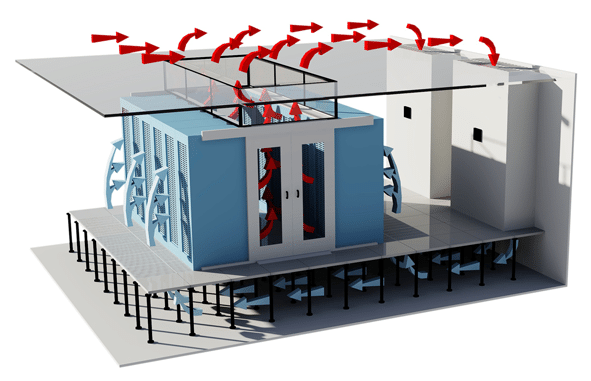
Air-cooled GPU servers should still use disciplined airflow management.
A typical arrangement is:
Cold aisle → Server intake → GPU/CPU → Hot aisle
The objective is to prevent hot exhaust air from recirculating into server intakes.
Good airflow management can include:
* Cold-aisle containment
* Hot-aisle containment
* Blanking panels
* Sealed cable openings
* Proper rack spacing
* Variable-speed fans
For high-density GPU racks, poor airflow management can create localized thermal hotspots even when average room temperature appears acceptable.
---
# 16. Rack Density Should Be Designed Around Cooling
Don't start with:
“How many GPU servers can fit in this rack?”
Start with:
“How many kilowatts can this rack reliably dissipate?”
Then calculate:
Rack power → Heat load → Cooling architecture → Rack capacity
For example:
4 × 8-GPU servers × 12 kW = 48 kW
before networking and additional rack infrastructure.
A rack may physically accommodate more equipment but still exceed its thermal design capacity.
---
# 17. Gulf AI Data Centers Need Peak-Load Modeling
A robust design should simulate:
Peak outdoor temperature + maximum GPU workload + maximum rack density
rather than average conditions.
For example:
### Normal operation
80% GPU utilization
### Peak AI training
100% GPU utilization
### Summer design day
High outdoor temperature
### Cooling failure
One chiller/CDU/pump unavailable
The facility should remain within the required operating envelope under the defined failure scenarios.
---
# 18. Power and Cooling Are Connected
GPU power density and cooling capacity should be planned together.
Suppose an AI cluster consumes:
5 MW of IT power
That means the facility needs to continuously remove approximately:
5 MW of IT heat
in addition to the facility's own cooling and electrical losses.
If the facility's PUE is 1.3:
5 MW × 1.3 = 6.5 MW total facility power
The remaining approximately:
1.5 MW
represents non-IT facility consumption in this simplified example.
This illustrates why AI infrastructure can become a major facility-level engineering project.
---
# 19. Designing for Blackwell and Future GPUs
The thermal design should not be based only on today's GPU generation.
The industry is moving toward increasingly dense AI systems.
ASHRAE's recent guidance emphasizes that rising chip power is driving the transition toward liquid cooling and that alternatives to liquid cooling can include lower data-center air temperatures, reduced compute performance, less space-efficient servers, or substantially higher airflow and fan power. ([ASHRAE Dallas Chapter][3])
This means a new Gulf data center should ideally be:
liquid-cooling ready
even if the first deployment contains some air-cooled systems.
---
# 20. Designing a Liquid-Cooling-Ready Data Hall
A future-ready AI data hall should consider:
* CDU locations
* Facility-water connections
* Supply/return piping
* Leak detection
* Drainage
* Pump redundancy
* Maintenance access
* Rack manifolds
* Quick-disconnects
* Water-quality monitoring
* Additional electrical capacity
Retrofitting these systems later can be significantly more disruptive than incorporating them into the original design.
---
# 21. AI Cluster Architecture for Gulf Conditions
A practical high-density AI architecture could look like:
```text
GULF OUTDOOR ENVIRONMENT
│
▼
┌──────────────────────┐
│ Heat Rejection Plant │
│ Chiller / Tower / │
│ Dry Cooler / Hybrid │
└──────────┬───────────┘
│
Facility Water
│
▼
┌──────────────────────┐
│ CDU │
│ Pump + HX + Control │
└──────────┬───────────┘
│
Technology Loop
│
┌──────────────┼──────────────┐
▼ ▼ ▼
GPU Rack GPU Rack GPU Rack
50–100kW+ 50–100kW+ 50–100kW+
│ │ │
└──────────────┼──────────────┘
▼
AI Compute Cluster
```
The exact rack density depends on the GPU platform and server design, but the key principle remains:
The cooling system must be designed as part of the AI cluster.
---
# 22. How to Choose Between Air and Liquid Cooling
### Air Cooling
Can make sense when:
* Rack density is moderate
* GPU power is relatively low
* Existing HVAC infrastructure is sufficient
* The facility has adequate airflow
* Future density is limited
### Liquid Cooling
Becomes increasingly attractive when:
* GPU power density is high
* Rack power approaches very high levels
* Multiple high-power GPUs share a rack
* Airflow becomes impractical
* Future GPU upgrades are expected
* Energy efficiency is important
ASHRAE's guidance confirms that liquid cooling is increasingly necessary as heat densities rise. ([ASHRAE Handbook Online][1])
---
# 23. Common Gulf GPU Data Center Design Mistakes
### Mistake 1: Designing for Average Temperature
Peak summer conditions matter more for cooling capacity.
### Mistake 2: Treating GPUs Like Conventional Servers
High-density GPU racks have radically different thermal profiles.
### Mistake 3: Ignoring Outdoor Heat Rejection
The indoor cooling system is only one part of the thermal chain.
### Mistake 4: Planning Only for Current GPUs
Future accelerator generations can require substantially higher rack power.
### Mistake 5: Ignoring Water Availability
Cooling towers and liquid cooling introduce water-management requirements.
### Mistake 6: Underestimating Redundancy
A single failed pump or CDU can affect a large amount of compute capacity.
### Mistake 7: Focusing Only on Temperature
Humidity, dew point, dust, airflow, and water quality also matter.
---
# 24. Gulf AI Data Center Design Checklist
Before deploying high-density GPU infrastructure, evaluate:
### Climate
* [ ] Peak outdoor temperature
* [ ] Design dry-bulb temperature
* [ ] Humidity
* [ ] Dew point
* [ ] Dust/air quality
* [ ] Seasonal conditions
### GPU Infrastructure
* [ ] GPU model
* [ ] GPU TDP
* [ ] Server power
* [ ] Rack power
* [ ] Rack density
* [ ] Future GPU requirements
### Cooling
* [ ] Air or liquid cooling
* [ ] Chiller capacity
* [ ] Cooling tower/dry cooler
* [ ] CDU capacity
* [ ] Pump redundancy
* [ ] Water quality
* [ ] Leak detection
* [ ] Heat rejection
### Electrical
* [ ] Utility capacity
* [ ] UPS
* [ ] Generator
* [ ] PDU
* [ ] Rack power
* [ ] A/B feeds
### Operations
* [ ] Thermal monitoring
* [ ] Water monitoring
* [ ] Preventive maintenance
* [ ] Emergency procedures
* [ ] Spare components
* [ ] Commissioning
---
# Final Takeaway
Gulf temperatures fundamentally change the economics and engineering of GPU data centers.
The combination of high ambient temperatures, high rack power density, and continuously loaded AI accelerators means that cooling must be considered at the same time as GPU selection, electrical distribution, rack architecture, and data-center design.
ASHRAE's current guidance recognizes the increasing difficulty of cooling high-density GPU infrastructure with air alone and identifies liquid cooling as an increasingly important solution for modern high-power AI equipment. ([ASHRAE Handbook Online][1])
For lower-density deployments, carefully designed air cooling can remain practical. For increasingly dense H200, B200, B300, GB200, GB300, and AMD Instinct deployments, however, direct-to-chip liquid cooling and properly engineered heat-rejection infrastructure should be evaluated from the beginning.
The core design principle is:
In the Gulf, don't design the AI data center around the GPU rack. Design the GPU rack around the climate, power, and cooling system.
A future-ready Gulf AI facility should therefore prioritize peak-temperature resilience, liquid-cooling readiness, high-density power distribution, water and heat-rejection efficiency, redundancy, and the ability to accommodate the next generation of increasingly powerful accelerators.