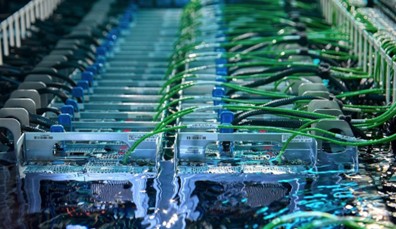
As GPU servers become increasingly powerful and compute-dense, liquid cooling for GPU servers is moving from a specialized option to an essential data-center technology. Modern AI accelerators such as NVIDIA H200, B200, B300, GB200, and GB300 systems can generate significantly more heat than traditional CPU-based servers, making thermal management a critical consideration when building high-density AI infrastructure.
For organizations deploying AI clusters, LLM training systems, generative AI infrastructure, and high-performance GPU servers, the question is no longer simply whether liquid cooling is more efficient than air cooling. The key question is:
At what GPU and rack density does liquid cooling become necessary?
Why GPU Servers Are Getting Harder to Cool
AI workloads place sustained, intensive workloads on GPUs. Unlike conventional enterprise servers, AI systems can operate multiple high-power accelerators continuously for training and inference.
As GPU performance increases, so does power density.
A single high-end GPU server can contain multiple accelerators, while an AI rack may contain many servers operating simultaneously. This creates significantly higher thermal loads within the same physical space.
The result is a growing need for advanced cooling technologies that can remove heat efficiently without requiring extreme volumes of room air.
When Does Liquid Cooling Become Mandatory?
There is no single GPU power threshold that makes liquid cooling mandatory for every data center. The answer depends on GPU power, server configuration, rack density, facility cooling capacity, ambient conditions, and the thermal design of the system.
However, liquid cooling becomes increasingly difficult to avoid when:
GPU power reaches very high levels
Multiple high-power GPUs are installed in one server
Rack power density becomes extremely high
Traditional air cooling cannot maintain required temperatures
Data-center airflow becomes impractical
Additional racks cannot be added because of facility constraints
AI workloads operate at sustained high utilization
For modern high-density AI infrastructure, the rack is often the correct unit of analysis rather than the individual GPU.
A GPU may be technically air-cooled, but hundreds of kilowatts of compute in a rack can create a facility-level thermal problem.
Air Cooling vs. Liquid Cooling
Traditional air cooling uses fans, heat sinks, cold air, and data-center HVAC systems to transfer heat away from GPUs and CPUs.
Liquid cooling transfers heat through a liquid medium, which has significantly higher heat-transfer capacity than air.
Air Cooling
Advantages:
Simple infrastructure
Familiar maintenance procedures
Lower initial complexity
Compatible with conventional data centers
Easier deployment at lower power densities
Limitations:
Requires substantial airflow
Becomes more difficult at high rack densities
Can require larger cooling infrastructure
Fan power increases with thermal load
Hot spots become harder to manage
Liquid Cooling
Advantages:
Much higher heat-transfer efficiency
Supports high-density GPU servers
Reduces dependence on massive airflow
Can improve thermal consistency
Enables higher rack power densities
Better suited to next-generation AI infrastructure
Limitations:
Higher infrastructure complexity
Requires liquid distribution systems
Requires leak detection and maintenance procedures
May require facility modifications
Higher initial deployment cost
Direct-to-Chip Liquid Cooling
The most common approach for high-performance AI infrastructure is direct-to-chip liquid cooling.
In this architecture, cold plates are attached directly to high-power components such as GPUs and CPUs. Coolant flows through the cold plates and removes heat directly from the components.
The heated liquid then flows to a coolant distribution unit (CDU), where heat is transferred to the facility cooling system.
A typical architecture looks like:
GPU → Cold Plate → Coolant Loop → CDU → Facility Water Loop → Heat Rejection
This approach allows the most thermally demanding components to be cooled directly rather than relying entirely on room air.
What Is a Coolant Distribution Unit?
A CDU, or coolant distribution unit, is a critical component in a liquid-cooled AI data center.
It separates the IT-side cooling loop from the facility-side water system while controlling:
Coolant flow
Temperature
Pressure
Heat transfer
Fluid quality
Monitoring
The CDU effectively acts as the interface between the GPU server and the building's cooling infrastructure.
For large AI clusters, multiple CDUs may be required depending on rack count and thermal load.
Why AI Training Is Particularly Demanding
AI training workloads can maintain high GPU utilization for extended periods.
A GPU that operates near peak utilization continuously produces a sustained thermal load.
This differs from many traditional enterprise workloads, which may have more variable utilization patterns.
For LLM training, the cluster may operate dozens or hundreds of GPUs simultaneously for days or weeks.
Thermal infrastructure therefore needs to be designed around sustained operation rather than short-term peak temperatures.
High-Density AI Racks
One of the strongest indicators that liquid cooling should be considered is rack power density.
Traditional enterprise racks may operate at relatively modest power levels. Modern AI racks can be dramatically denser.
High-density GPU platforms can combine:
Multiple high-power GPUs
High-performance CPUs
High-speed networking
Large memory configurations
NVMe storage
High-speed GPU interconnects
The combined thermal output can quickly exceed what conventional room-level air cooling can efficiently handle.
This is why next-generation AI infrastructure increasingly uses liquid-cooled racks rather than simply increasing the number of fans and air-conditioning units.
NVIDIA Blackwell and Liquid Cooling
The rise of NVIDIA Blackwell-based systems has accelerated interest in liquid cooling.
Platforms such as NVIDIA B200, B300, GB200, and GB300 are designed for very high-density AI computing. Rack-scale systems can combine large numbers of GPUs into tightly integrated platforms, significantly increasing rack-level thermal requirements.
For these environments, liquid cooling can provide a more practical way to remove heat while maintaining high compute density.
Does Every H200 or B200 Server Need Liquid Cooling?
No.
This is an important distinction.
A single GPU server may be designed and certified for air cooling. Whether liquid cooling is required depends on the specific server design and facility environment.
However, as more high-power GPUs are concentrated into a single rack, air cooling becomes progressively more challenging.
The correct question is therefore:
Can the complete server and rack maintain required GPU temperatures at sustained workload utilization using the available facility cooling capacity?
If the answer is no, liquid cooling becomes necessary.
How to Determine If Your AI Cluster Needs Liquid Cooling
Before purchasing GPU servers, evaluate five major factors.
1. GPU TDP
Higher GPU power means more heat that must be removed.
Calculate the total accelerator power rather than evaluating only one GPU.
2. Server GPU Count
An eight-GPU server produces substantially more heat than a single-GPU system.
The CPU, memory, NICs, and other components also contribute to the total thermal load.
3. Rack Density
Calculate the total power of all equipment installed in the rack.
For example:
8 GPUs × GPU power + CPU + memory + networking + storage + overhead = total rack heat load
4. Facility Cooling Capacity
Your data center must be able to remove the heat generated by the rack continuously.
Existing HVAC infrastructure may not be designed for modern AI power densities.
5. Sustained Workload
A training cluster operating at 90–100% GPU utilization creates a very different thermal profile from a development environment with intermittent GPU activity.
Liquid Cooling Technologies
Liquid cooling is not a single technology. Several approaches exist.
Direct-to-Chip
Cold plates directly cool GPUs and CPUs.
Best for: High-density AI and HPC servers.
Rear-Door Heat Exchangers
A heat exchanger is installed at the rear of the rack to remove heat from server exhaust air.
Best for: Facilities transitioning from conventional air cooling.
Immersion Cooling
Servers or components are submerged in specialized dielectric fluid.
Best for: Extremely high-density or specialized environments.
Immersion cooling can provide excellent thermal performance, but it requires a substantially different server and maintenance architecture.
Liquid Cooling and Energy Efficiency
Liquid cooling can also reduce the amount of energy required to move and condition air.
Fans consume power, and large-scale air cooling requires substantial airflow infrastructure.
By removing heat closer to the source, liquid cooling can reduce the thermal burden on the broader data-center environment.
However, total energy efficiency depends on the complete cooling architecture, including pumps, CDUs, chillers, heat exchangers, and facility water systems.
The right metric is therefore the total facility power usage, not simply the efficiency of the cold plate.
Liquid Cooling Maintenance
Liquid cooling introduces additional operational requirements.
A production deployment should include:
Leak detection
Coolant monitoring
Pressure monitoring
Flow monitoring
Temperature monitoring
Pump redundancy
CDU redundancy where appropriate
Preventive maintenance
Compatible coolant selection
Proper hose and connector design
Reliability should be designed into the system from the beginning.
For mission-critical AI infrastructure, cooling should not become a single point of failure.
The Economics of Liquid Cooling
Liquid cooling generally requires higher upfront infrastructure investment.
However, the economics can become favorable when it enables:
Higher GPU density
More compute per rack
Better facility utilization
Reduced airflow requirements
Higher sustained GPU performance
More efficient thermal management
For large AI clusters, the relevant metric is not simply cooling cost per rack.
Instead, evaluate:
Cooling cost per GPU + compute density + energy efficiency + facility utilization + operational cost
When Liquid Cooling Becomes the Better Choice
Liquid cooling should be strongly considered when:
High GPU power + high GPU count + high rack density + sustained utilization
combine to exceed the practical limits of your existing air-cooling infrastructure.
For smaller AI servers, air cooling may remain perfectly adequate.
For high-density AI clusters and rack-scale systems, liquid cooling can become the only practical path to maintaining temperature, performance, reliability, and facility efficiency.
2026 AI Infrastructure Trend
As AI models become larger and inference demand increases, GPU infrastructure is moving toward higher compute density.
This means the thermal challenge is shifting from:
“How do we cool a GPU?”
to:
“How do we remove hundreds of kilowatts of heat from an AI rack?”
That change is driving greater adoption of direct-to-chip liquid cooling, CDUs, liquid-cooled racks, and advanced data-center cooling architectures.
Final Takeaway
Liquid cooling for GPU servers is not automatically mandatory for every AI deployment. It becomes necessary when the thermal output of the GPU servers exceeds what the available air-cooling infrastructure can reliably handle.
For low-density AI deployments, air cooling can remain the simplest and most economical solution. As organizations move toward 8-GPU servers, high-power Blackwell systems, rack-scale AI platforms, and large LLM clusters, liquid cooling becomes increasingly important.
The best time to evaluate liquid cooling is before purchasing the GPU servers, not after the racks have already been installed.
A successful AI infrastructure design should therefore evaluate GPU power, server density, rack power, cooling capacity, networking, facility infrastructure, and future expansion together. This approach ensures that the cooling system can support the AI cluster not only on day one, but throughout its expected operational lifetime.